PCOS
PCOS and Insulin Resistance: Breaking the Weight Gain Cycle in Your 20s and 30s
Eating clean and still gaining weight is not a willpower problem. With PCOS it is usually insulin.
- Written by
- Farhat Ali Khan
- Published
- Updated
- Reading time
- 3 minutes
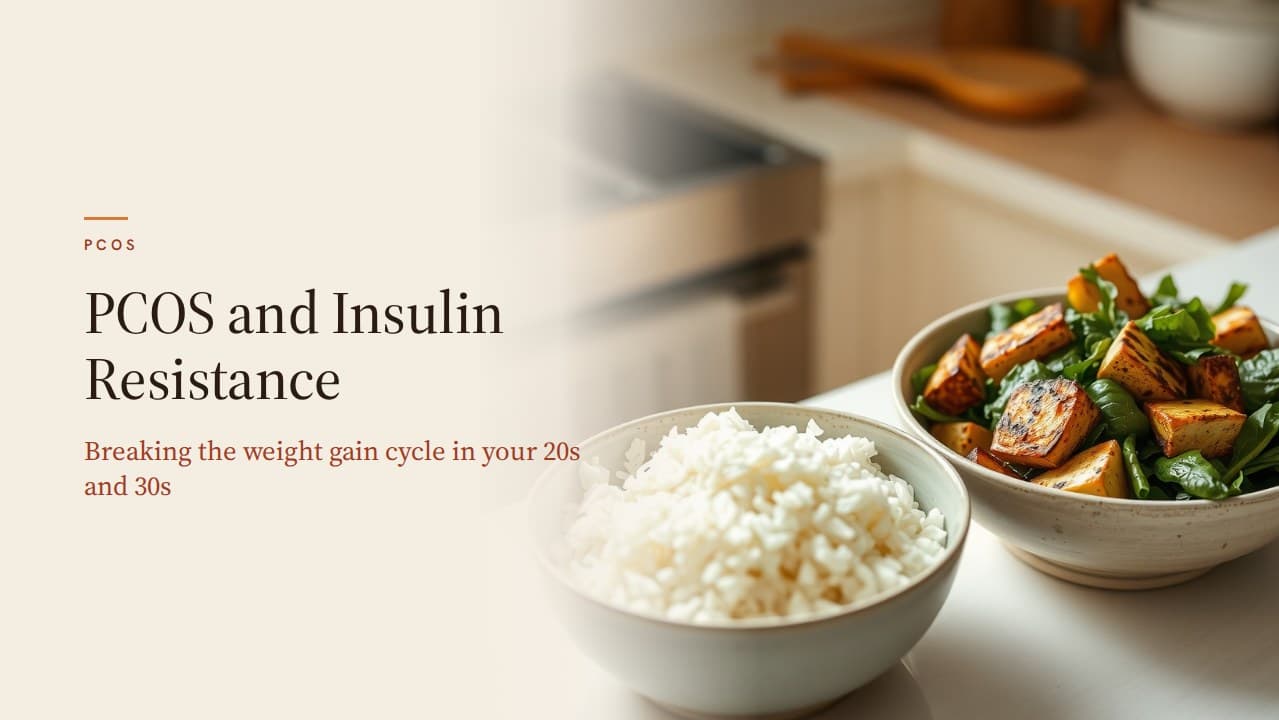
For many women with PCOS, high insulin drives the ovaries to make excess testosterone, which adds belly fat, which worsens insulin resistance. Refined carbohydrates like white rice, maida and sweets feed the loop. Fasting insulin, HbA1c, lipids, free testosterone and SHBG show how strongly insulin is affecting your hormones, before any weight loss plan begins.
The short version
- High insulin and high testosterone feed each other in a loop.
- White rice, maida and sweets cause large blood sugar spikes.
- Fasting insulin, HbA1c, lipids, free testosterone and SHBG come before any plan.
- Protein and healthy fats, strength training and targeted clinical support lower insulin.
Sound like you? Our 2-minute health assessment shows which causes are worth checking first.
One of the most frustrating aspects of PCOS for young urban professionals is the seemingly unstoppable weight gain. You might be eating clean and exercising daily, yet the scale continues to climb.
This is not a failure of willpower. It is a biological roadblock. For up to 70 percent of women with the condition, the root cause is profound insulin resistance. Understanding the link between PCOS and insulin resistance is the only way to break the weight gain cycle in your 20s and 30s.
The Vicious Cycle of High Insulin and High Testosterone
Insulin is a fat-storage hormone. When your cells become resistant to it, your pancreas produces more and more insulin to try and force glucose into your cells.
In women with PCOS, these high insulin levels act directly on the ovaries, triggering them to produce excess testosterone. This high testosterone causes belly fat accumulation, which in turn causes more insulin resistance. It is a devastating biochemical loop that makes PCOS weight loss in India incredibly difficult without clinical intervention.
Why the Standard Indian Diet Exacerbates PCOS
The traditional urban Indian diet can be a trigger for insulin-resistant PCOS. Heavy reliance on refined carbohydrates like white rice, maida (refined wheat), and sugary sweets causes massive spikes in blood sugar.
When you combine a highly insulinogenic diet with a sedentary corporate lifestyle, you are pouring gasoline on the fire of hormonal imbalance. Modifying this diet is the first clinical fix for reversing symptoms naturally.
Deep Testing for Metabolic Markers
Before starting any weight loss protocol, you need deep clinical data. A standard fasting glucose test is not enough to diagnose insulin resistance in its early stages.
You must test your Fasting Insulin, HbA1c, and your lipid profile. Additionally, checking your Free Testosterone and SHBG (Sex Hormone-Binding Globulin) will show exactly how heavily insulin is impacting your reproductive hormones.
Targeted Clinical Interventions
Reversing insulin-resistant PCOS requires a multi-pronged approach based on your deep testing data. The goal is to lower insulin levels so your ovaries can function normally again.
This involves prioritizing protein and healthy fats to stabilize blood sugar, utilizing strength training to build muscle (which absorbs excess glucose), and potentially using clinical supplements like Inositol to improve cellular insulin sensitivity. Book a deep root-cause blood test with Opwel to get your personalized protocol.
Common questions
High insulin levels act on the ovaries and trigger excess testosterone. That testosterone adds belly fat, which causes more insulin resistance, creating a cycle.
For many women with PCOS the root cause is insulin resistance, which keeps the body in fat-storage mode regardless of effort.
Fasting insulin, HbA1c, a lipid profile, free testosterone and SHBG.
Written by Farhat Ali Khan, Co-founder, Opwel.
Published . Last updated .
General health information. It is not medical advice and it is not a substitute for a consultation about your own situation.
This article is general health information. It is not a diagnosis and it is not advice about your own health; speak to a doctor before changing your treatment, diet or supplements.